




LUCA, LECA and the common ancestors of the tree of life
PDFAll living things on Earth share a common origin. To understand the history of life on Earth, biologists have reconstructed several hypothetical common ancestors. The two most important are LUCA (Last Universal Common Ancestor) and LECA (Last Common Ancestor of Eukaryotes). Other, more specialised ancestors have also been proposed [1], but LUCA and LECA are the key reference points. Figure 1 places LUCA and LECA on the broad timeline of the evolution of life (Figure 1) [2].
1. LUCA: the Last Universal Common Ancestor
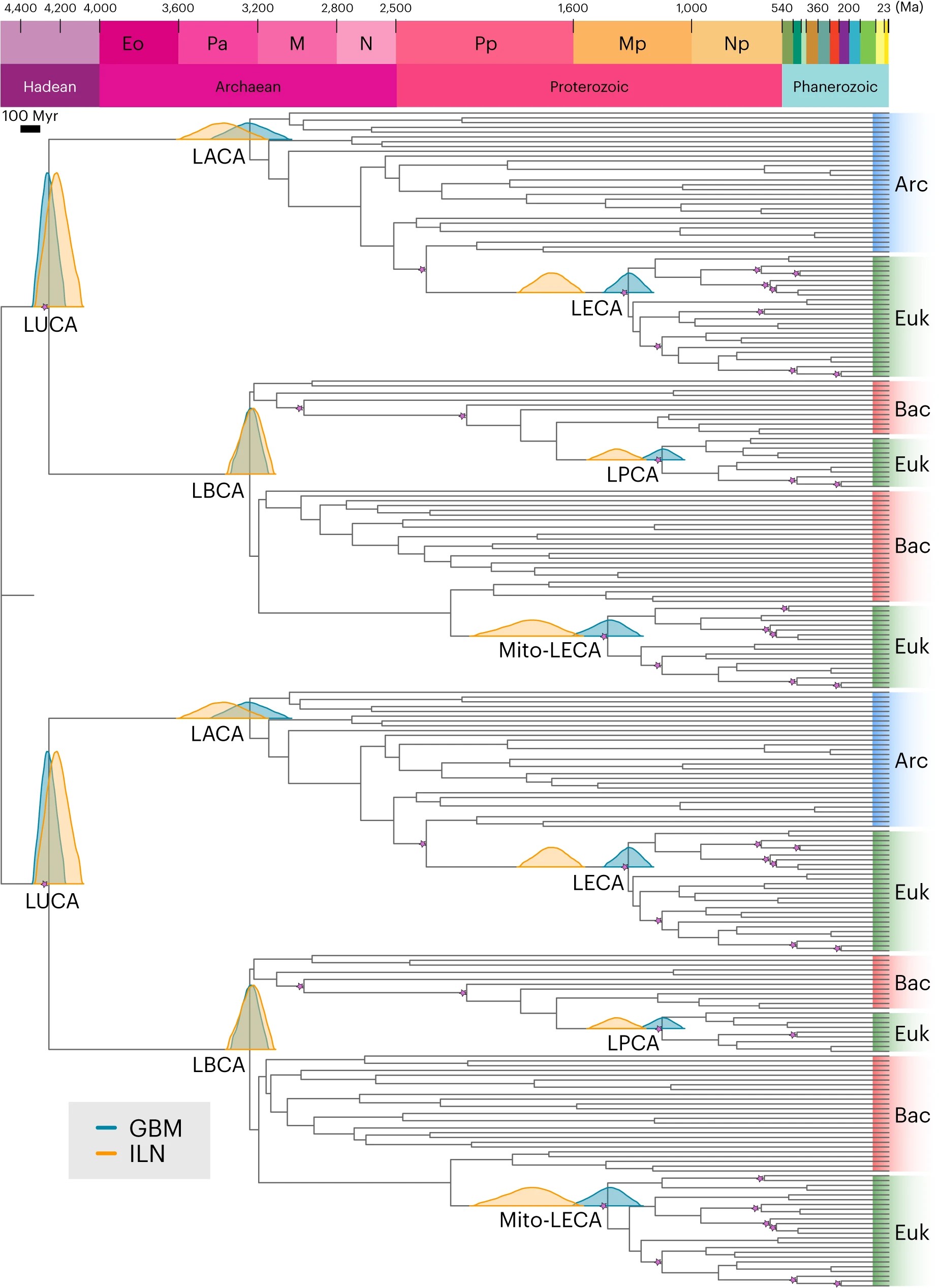
To estimate this age, researchers compared very ancient genes present in all modern organisms. The differences that have accumulated over time serve as a ‘molecular clock’, enabling the age of their common ancestor to be estimated.
The nature of LUCA’s metabolism remains a matter of debate. Some hypotheses propose that LUCA already possessed most of the major metabolic pathways, whereas others describe a simpler organism, still heavily dependent on its geochemical environment. Recent reconstructions, based on phylogenomics and molecular clocks, suggest that LUCA already possessed a relatively complex genome of around 2,500 to 2,600 genes, a size comparable to that of many modern prokaryotes. It already possessed several complex metabolic pathways enabling it to produce energy in the absence of oxygen, notably through acetogenesis. LUCA probably did not live in isolation, but within an already diverse ecosystem comprising other microorganisms that are now extinct.
LUCA was not the very first living organism; it represents the ancestral population from which the lineages that would later give rise to Bacteria and Archaea originated.
2. LECA: the Last Common Ancestor of Eukaryotes
After more than two billion years of evolution of bacterial and archaeal lineages, LECA emerged. It marks a major turning point in the history of life: the transition from a relatively simple prokaryotic organisation to eukaryotic complexity, which, several hundred million years later, would pave the way for the evolution of multicellular organisms (animals, plants, fungi, protists, etc.). Its origin most likely resulted from a close association between an Asgard archaeon and a bacterium (see Symbiosis and evolution: the origin of the eukaryotic cell).
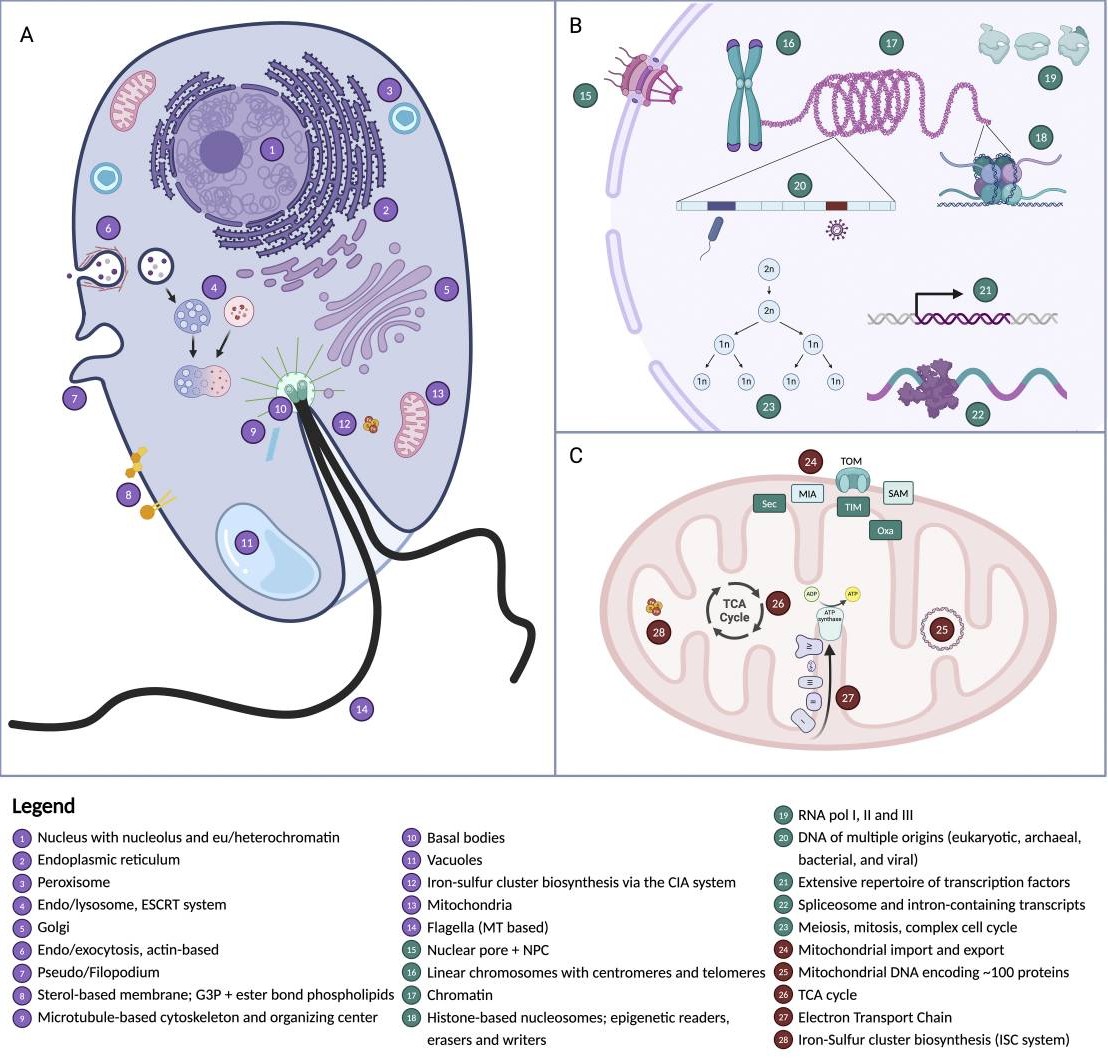
- A nucleus with linear chromosomes and a sophisticated RNA transcription and splicing machinery [3],[6].
- A complex cytoskeleton composed of actin, tubulin and motor proteins [3].
- An endomembrane system (endoplasmic reticulum, Golgi apparatus, vesicles).
- The ability to carry out phagocytosis (ingestion of particles).
- Mitochondria derived from an endosymbiotic alpha-proteobacterium.
- The mechanisms of mitosis, meiosis and a form of sexual reproduction.
Figure 2 illustrates some of the many cellular structures that researchers believe were already present in LECA. Richards et al. [5] have produced a consensus review that summarises the current state of knowledge and proposes a collaborative methodological framework for reconstructing the genetic repertoire of LECA. This body of work provides a useful tool for evaluating the various hypotheses concerning the origin of eukaryotes and for understanding the evolution of traits across all descendant lineages, which is of interest in various fields such as cell biology, microbial ecology, biotechnology, agriculture and medicine.
3. LUCA and LECA in three key points
- LUCA (≈ 4.2 billion years ago) is the last universal common ancestor of all present-day cellular organisms
- LECA (≈ 1.5–1.8 billion years ago) is the last common ancestor of all eukaryotes (animals, plants, fungi and protists).
- Between LUCA and LECA, more than two billion years of evolution led from ancestral prokaryotic cells to the complex eukaryotic cell, which gave rise to the full diversity of multicellular organisms.
These concepts continue to be refined through new discoveries (Asgard archaeal genomes, improvements in bioinformatics methods). The more new genomes we discover, the more the history of life appears to be one of immense kinship. LUCA and LECA are not merely two acronyms used by biologists. They represent two key milestones in the history of life: the former links all present-day cellular organisms, whilst the latter marks the emergence of the complex eukaryotic cell, from which animals, plants, fungi and humans are descended.
These discoveries show just how unified and ancient life on Earth is. They also raise a fascinating question: how could life have emerged and become so complex so quickly after the formation of our planet?
Notes & references
Thumbnail. [Schéma EEnv]
[1] LUCA (Last Universal Common Ancestor) – LACA (Last Archaeal Common Ancestor) – LBCA (Last Bacterial Common Ancestor) – LECA (Last Eukaryotic Common Ancestor): Last Common Ancestor of Eukaryotes – Mito-LECA (Last Mitochondrial Lineage Common Ancestor): Last Common Ancestor of the mitochondrial lineage, LPCA (Last Plastidial Common Ancestor): Last Common Ancestor of plastid-bearing organisms.
[2] Moody, E.R.R., Álvarez-Carretero, S., Mahendrarajah, T.A. et al. (2024). The nature of the last universal common ancestor and its impact on the early Earth system. Nat Ecol Evol 8, 1654–1666. https://doi.org/10.1038/s41559-024-02461-1
[3] Cox R, Papoulas O, Shril S … (2026). A protein interactome for the last eukaryotic common ancestor illuminates the biochemical basis of modern genetic diseases. Cell Genomics; 6
[4] Koumandou, V. L., Wickstead, B., Ginger, M. L., van der Giezen, M., Dacks, J. B., & Field, M. C. (2013). Molecular palaeontology and complexity in the last common eukaryotic ancestor. Critical Reviews in Biochemistry and Molecular Biology, 48(4), 373–396. https://doi.org/10.3109/10409238.2013.821444
[5] Richards TA, Eme L, Archibald JM, Leonard G, Coelho SM, et al. (2024). Reconstructing the last common ancestor of all eukaryotes. PLoS Biol. 25 Nov;22(11):e3002917. doi: 10.1371/journal.pbio.3002917. PMID: 39585925; PMCID: PMC11627563.
[6] Koonin EV. (2006). The origin of introns and their role in eukaryogenesis: a compromise solution to the introns-early versus introns-late debate? Biol Direct. 1:22. doi: 10.1186/1745-6150-1-22. PMID: 16907971; PMCID: PMC1570339