



Assessing the scale of biodiversity collapse
PDFThe term ‘collapse’ does not mean that all life is disappearing simultaneously. It refers to a series of rapid, large-scale declines observed at several levels: habitat destruction and fragmentation, population decline, increased extinction risk, erosion of genetic diversity and disruption of ecological interactions. No single indicator can capture all these changes on its own..
1. Transformed habitats and declining populations
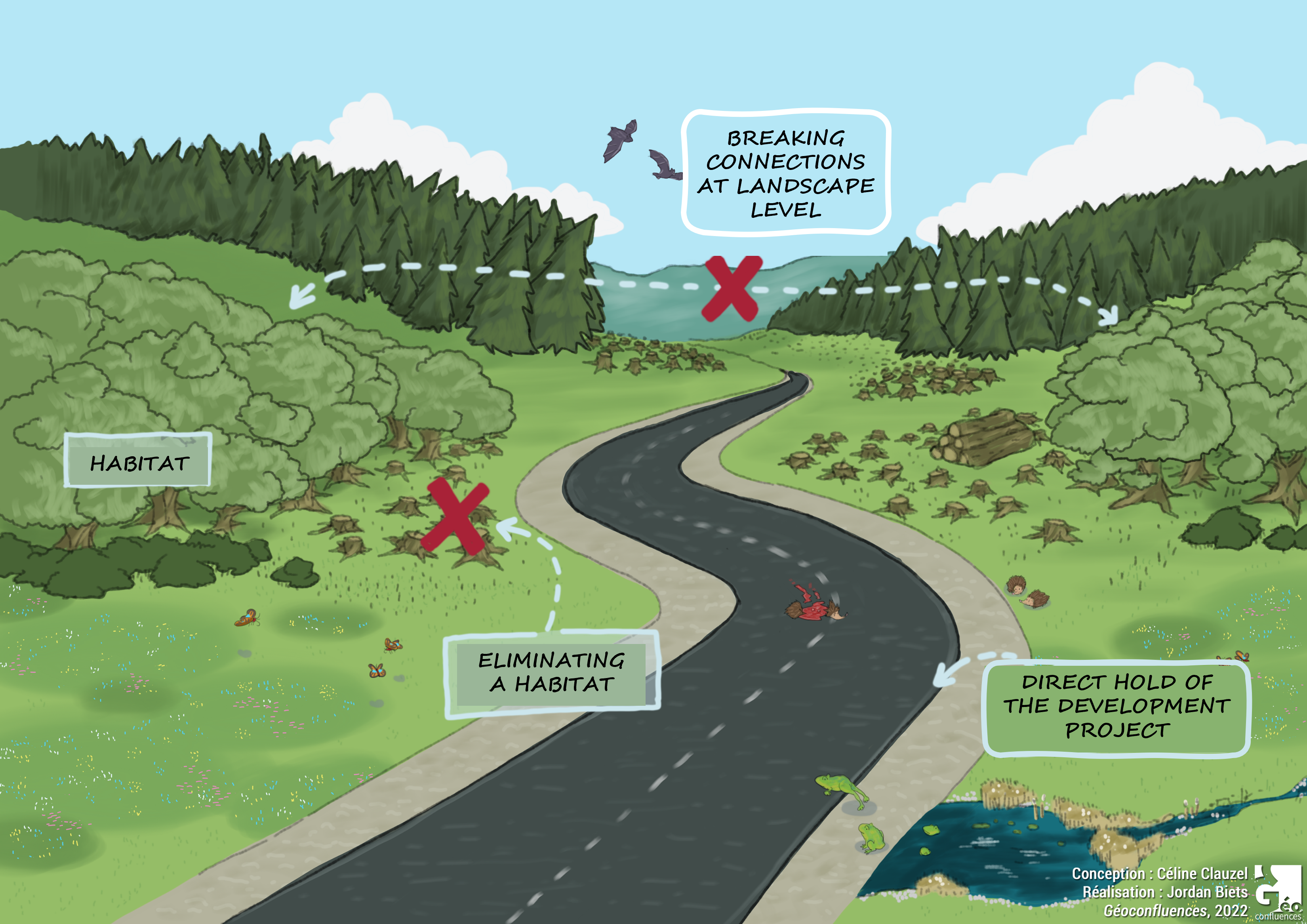
Habitat fragmentation also reduces connectivity, isolating some populations and limiting movement or genetic exchange between them (Figure 1).
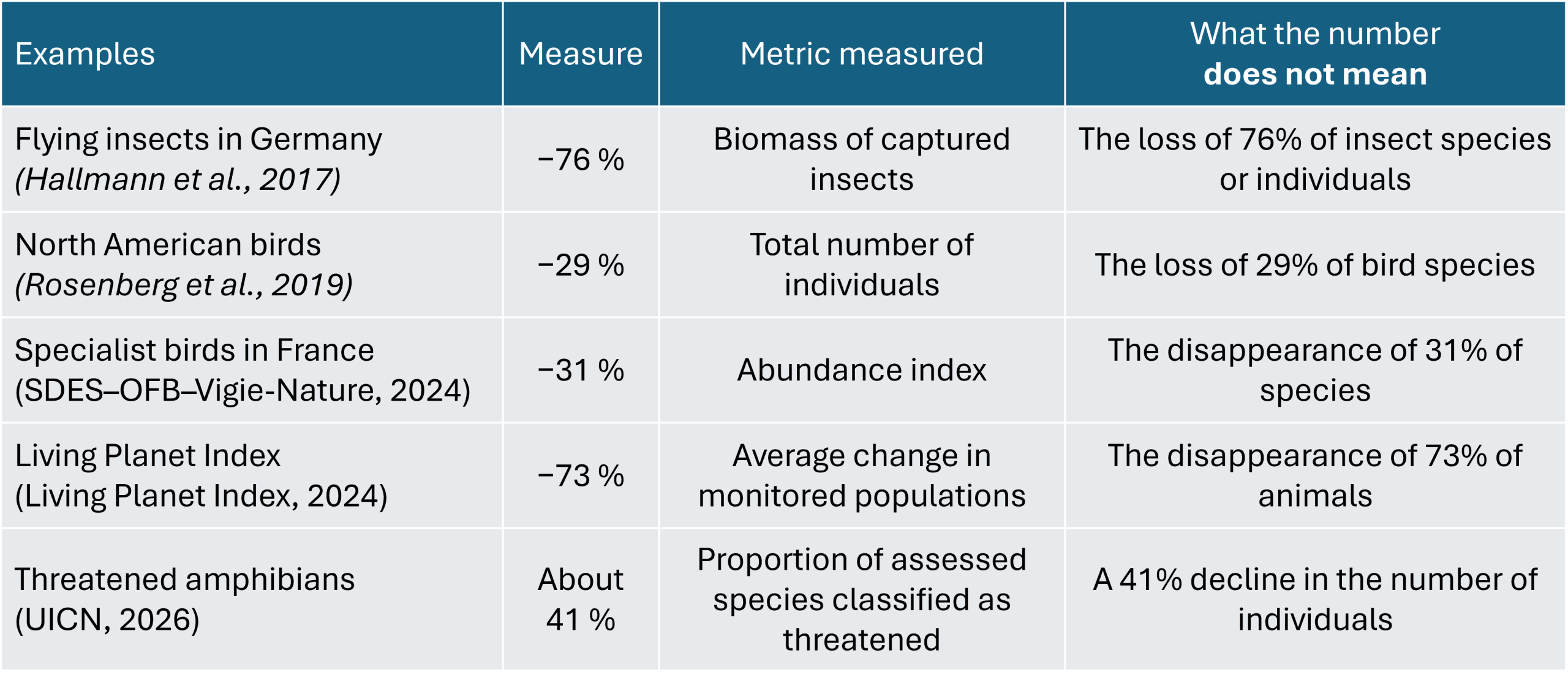
These differences can be seen in field monitoring studies (Table 1). In 63 protected areas in Germany, the biomass of flying insects caught in traps declined by 76% between 1989 and 2016 [2]. This does not mean that 76% of insects or insect species disappeared.
In North America, the decline was estimated from the number of individuals: bird populations lost nearly three billion individuals between 1970 and 2017, representing approximately 29% of their total abundance [3]. This therefore does not mean that 29% of bird species disappeared. In metropolitan France, the abundance of common specialist birds declined by 31% between 1989 and 2023 [4].
The Living Planet Index uses yet another measure: it summarises the average change in the relative abundance of monitored vertebrate populations. Its 73% decline between 1970 and 2020 therefore means neither that 73% of vertebrates disappeared nor that the total number of vertebrate individuals worldwide declined by exactly this proportion [5].
Table 1. Different measures used to assess biodiversity decline. Published percentages may describe a decline in biomass, in the number of individuals or in the average abundance of populations, or the proportion of species threatened with extinction. They are therefore not directly comparable and do not necessarily indicate a loss of species. Sources: Hallmann et al. (2017) [2]; Rosenberg et al. (2019) [3]; SDES–OFB–Vigie-Nature (2024) [4]; Living Planet Index (2024) [5]; IUCN Red List (2026) [6].
2. Decline often precedes extinction
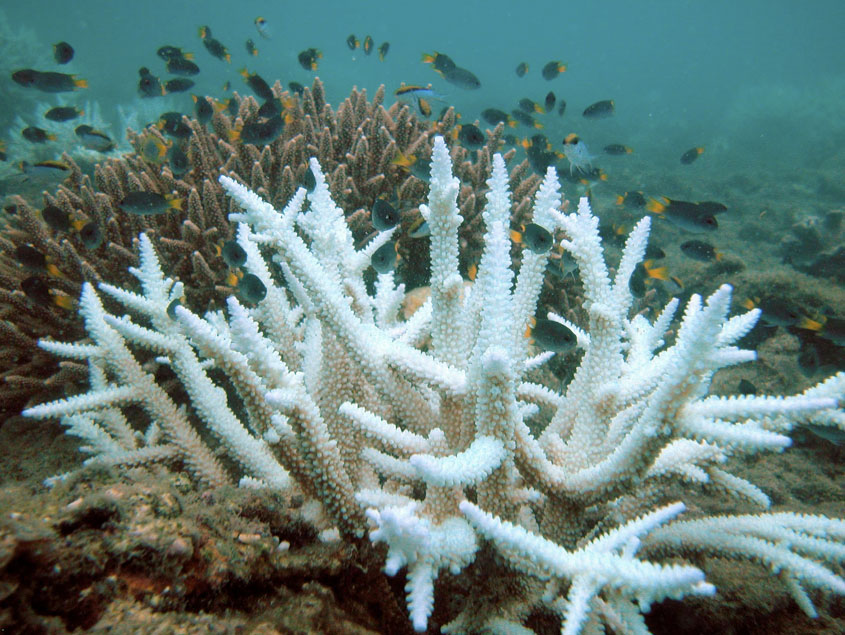
IPBES estimates that around one million animal and plant species are threatened with extinction [1], many of which may become extinct over the coming decades if pressures continue. Among the groups for which sufficient assessments have been carried out, the IUCN Red List estimates that around 41 per cent of amphibians (Table 1), 44 per cent of reef-building corals (Figure 2), 34 per cent of conifers and 26 per cent of mammals are threatened [6]. However, very little is known about the status of many invertebrates, fungi and microorganisms.
3. Losses that are sometimes invisible
The number of species present in a given location may remain stable whilst their composition changes profoundly. Specialised species may be replaced by more generalist species, sometimes the same ones from one region to another: this is referred to as biotic homogenisation. Certain generalist or introduced species may become more widespread in transformed habitats, without necessarily compensating for the decline of specialised species, unique evolutionary lineages or specific ecological functions.
This phenomenon is observed in many habitats, but it is not universal. A recent comprehensive review shows that human pressures profoundly alter community composition and reduce local diversity, but does not reveal a universal trend towards homogenisation: responses vary depending on the pressures, the organisms and the scales studied [7].
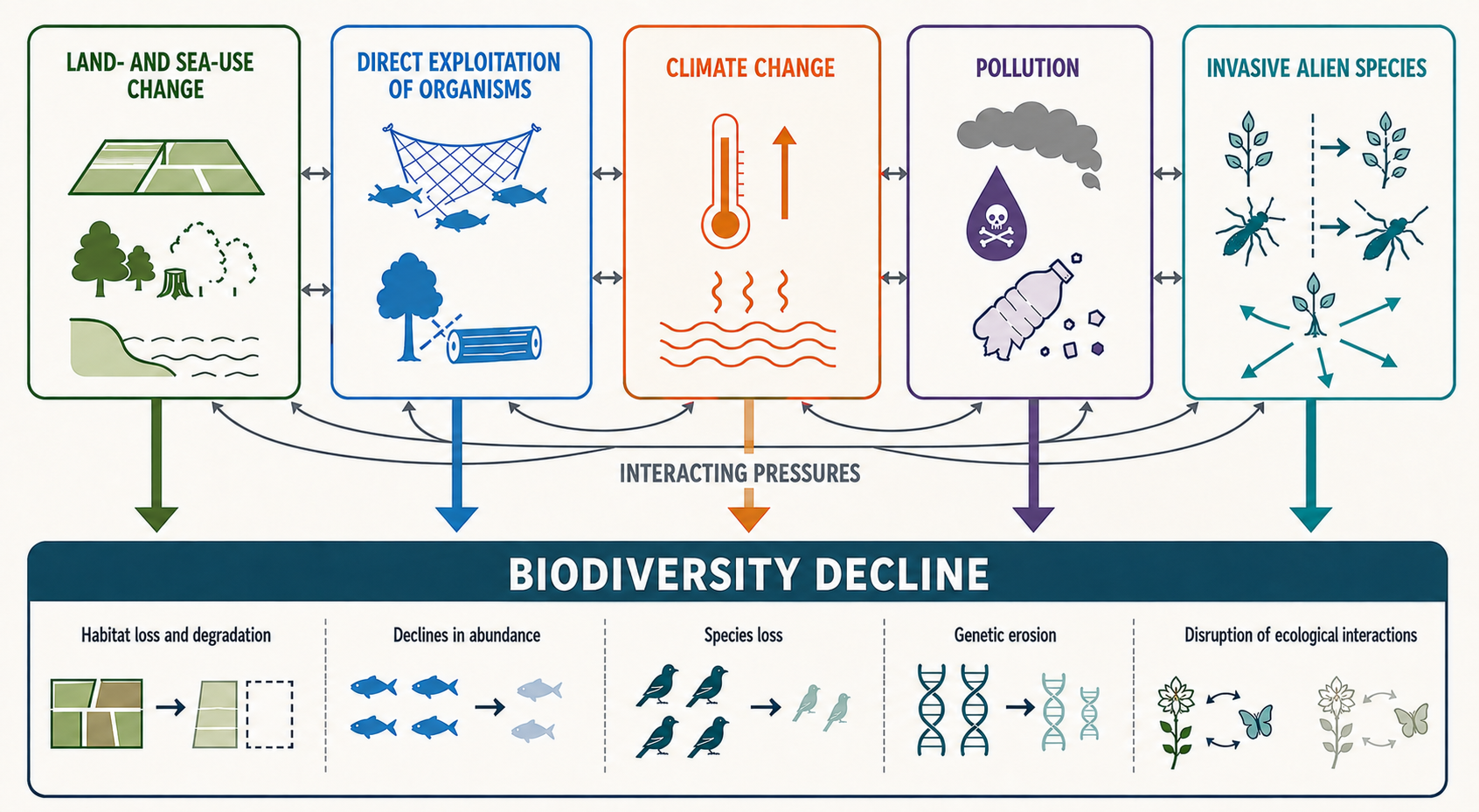
The main causes of these declines are well known: changes in land and marine use, direct exploitation of organisms, climate change, pollution and invasive alien species (Figure 3). They often interact and reinforce each other’s effects.
However, this trajectory is not irreversible. A synthesis of 186 studies, comprising 665 comparisons, shows that conservation actions have improved the state of biodiversity or slowed its decline in around two-thirds of the cases studied [8]. Their effectiveness, however, depends on their scale, duration and the simultaneous reduction of the pressures causing the declines.
4. Encyclopedia articles classified by the five direct drivers of biodiversity loss
Preliminary remark : this list was established on september 1, 2026
4.1 Changes in land and sea use
Core articles
- Impacts of agriculture on biodiversity and ecosystem functioning — Life
Conversion of natural habitats into cropland and pasture, agricultural intensification, habitat fragmentation and the replacement of specialist species by generalists. - Ecological networks: reconciling biodiversity conservation and land-use planning — Life
Habitat fragmentation, loss of connectivity and the integration of ecological networks into spatial planning. - What biodiversity in the city? — Life
Urbanisation, soil sealing, habitat transformation and biotic homogenisation. - The promises of ecological rehabilitation in port areas — Life
Particularly relevant to changes in sea use: port construction, irreversible destruction of coastal habitats and attempts at ecological rehabilitation. - Alpine alluvial landscapes and biodiversity — Life
River engineering, embankment, changing land uses and the simplification of alluvial landscapes. - Restoring savannas and tropical herbaceous ecosystems — Life
Agricultural conversion, urbanisation, inappropriate tree planting and changes in fire and grazing regimes. - Forests facing global environmental change — Life
Large-scale land clearing, intensive logging and the historical transformation of forest ecosystems. - Peatlands and marshes, remarkable wetlands — Life
Drainage, extraction and degradation of wetlands inhabited by many specialised species. - Amazonia: a huge ecosystem in constant evolution — Life
Deforestation, land conversion and the progressive anthropisation of the Amazon forest.
Supporting articles from other sections
- Understanding and preventing wildfires — Air
Fire as a historical land-management tool and the ecological effects of altering natural fire regimes. - The impact of agricultural practices on soil microbiological quality — Soil
Effects of tillage, crop rotations and different agricultural production systems on microbial biomass and diversity. - Zoonoses and environment — Health
Deforestation, habitat fragmentation, urbanisation and agricultural expansion as factors increasing contacts between wildlife, livestock and humans. - The Antarctic Treaty: a unique governance system for the environment and science — Society
Regulation of infrastructure, tourism and other human activities affecting Antarctic terrestrial and marine habitats.
4.2 Direct exploitation of organisms
Core articles
- Mathematical models can help to better manage fishing — Life
Overfishing, stock collapse and the possibility of continuing exploitation until a biological resource becomes virtually extinct. - Oysters: the little-known architects of coastal environments — Life
Historical overexploitation of native oyster beds and the loss of the habitats created by oyster reefs. - A history lesson — Focus/Life
Overfishing of the European flat oyster and the nineteenth-century “underwater deforestation” of oyster reefs. - Corals: ocean engineers are under threat — Life
Overfishing and unsustainable tourism acting alongside climate change and pollution. - Forests facing global environmental change — Life
Intensive logging and its consequences for forest structure and functioning.
Economic, social and health perspectives
- Economic theories in the face of the realities of environmental crises — Society
Exploitation of renewable resources, open-access resources such as high-seas fisheries and the limits of market regulation. - Economic theory and environment: a divorce? — Society
Economic growth, consumption choices, depletion of natural resources and degradation of natural capital. - Viral pandemics of the modern era — Health
Bushmeat hunting and consumption, poaching and wildlife trade. - Zoonoses and environment — Health
Hunting, wildlife handling and trade as pathways increasing exposure to animal pathogens. - The Antarctic Treaty: a unique governance system for the environment and science — Society
Historical overexploitation of seals and the subsequent protection of Antarctic fauna.
4.3 Climate change
Core biodiversity articles
- A carbon cycle disrupted by human activities — Life
Disruption of carbon flows by human activities, atmospheric CO₂ accumulation, global warming and ocean acidification affecting ecosystems. - Biodiversity responses to global changes — Life
Shifts in geographical ranges, plasticity, adaptation, community reorganisation and ecosystem tipping points. - How do birds adapt to a changing climate? — Life
Habitat tracking, migration, local adaptation and the risk of maladaptation or extinction. - Corals: ocean engineers are under threat — Life
Ocean warming, coral bleaching and ocean acidification. - Forests facing global environmental change — Life
Drought, heatwaves, altered phenology, pests and forest decline. - Biotic pests and forest decline — Focus/Life
Interactions between drought, heat and the spread of bark beetles, fungi, nematodes and other forest pests. - Climate change and globalisation, drivers of insect invasions — Life
Northward and uphill shifts in insect ranges and climate-assisted establishment of introduced species. - Ants as sentinels of the impact of global change — Life
Combined effects of climate change, urbanisation and biological invasions. - Restoring savannas and tropical herbaceous ecosystems — Life
Climate-driven aridification, woody encroachment and changes in the distribution of open ecosystems.
Other sections
- Understanding and preventing wildfires — Air
Increasing wildfire risk under repeated droughts and rising temperatures. - Zoonoses and environment — Health
Climate-related changes in the abundance and distribution of vectors and wildlife reservoirs. - Viral pandemics of the modern era — Health
Ecosystem disruption and the potential effects of climate change on vector-borne and zoonotic diseases. - The Antarctic Treaty: a unique governance system for the environment and science — Society
Climate change affecting Antarctic terrestrial and marine environments. - Morocco, a mosaic of climates — Climate
Increasing aridity, recurrent droughts, declining snow cover and threats to mountain and oasis ecosystems. - Role of forests in the planet’s carbon balance — Life
Interactions between deforestation, forest degradation and the global carbon cycle.
4.4 Pollution
Water and marine pollution
- Plastic pollution at sea: the seventh continent — Water
Entanglement, ingestion, chemical contamination and transport of organisms on floating debris. - Plastic, a danger to coral reefs — Focus/Life
Physical damage to corals and increased susceptibility to infectious disease. - Phosphorus and eutrophication — Water
Algal proliferation, oxygen depletion and disruption of aquatic ecosystems. - Why and how to treat urban wastewater? — Water
Organic pollution, nitrogen, phosphorus, micropollutants, endocrine disruption and oxygen depletion. - The oyster, sentinel of the coastline to be preserved — Life
Pesticides, pharmaceutical residues, heavy metals, hydrocarbons, toxic microalgae, microplastics and nanoplastics.
Soil and agricultural pollution
- Collembola: actors of soil life — Life
Effects of metals, pesticides, hydrocarbons, waste and exotic plants on soil communities. - Soil biodiversity — Soil
The biological richness of soils and the pressures exerted by pollution and land degradation. - Restoration of polluted soils by plants: phytoremediation — Soil
Trace-metal toxicity, mining impacts, loss of biodiversity and ecological rehabilitation. - The impact of agricultural practices on soil microbiological quality — Soil
Effects of intensive farming practices on microbial biomass and bacterial and fungal diversity. - How to feed plants while polluting less? — Life
Over-fertilisation, nutrient availability and the need to incorporate soil biological processes into fertilisation strategies.
Air pollution
- What is the impact of air pollutants on vegetation? — Life
Physiological effects on plants and disruption of plant–insect relationships and food webs. - Lichens and environmental quality — Life
Bioindication and accumulation of gaseous, particulate, aquatic and soil pollutants. - Air pollution and trees — Focus/Air
Combined effects of ozone, wildfire emissions and climate stress on forests.
Health and societal perspectives
- Mercury, fish and gold miners — Health
Mercury released by gold mining, aquatic contamination and transfer through fish-based food webs. - Economic theories in the face of the realities of environmental crises — Society
Environmental externalities, pollution costs, taxation and tradable pollution rights.
4.5 Invasive alien species
Core articles
- Climate change and globalisation, drivers of insect invasions — Life
International trade, introductions, establishment and climate-assisted expansion of alien insects. - Why is the tiger mosquito so invasive? — Life
Introduction pathways, repeated introductions, genetic diversity, road transport, urbanisation and population expansion. - When invasive plants also wander in the fields — Life
Invasive plants in agricultural landscapes, competition, allelopathy and changes in soil properties. - Ants as sentinels of the impact of global change — Life
Competitive displacement, predation, hybridisation and alteration of ecosystem functioning by invasive ants.
Complementary articles from other sections
- What biodiversity in the city? — Life
Cities as entry points and favourable habitats for non-native species. - Collembola: actors of soil life — Life
Effects of introduced plants on soil characteristics and native soil communities. - Plastic pollution at sea: the seventh continent — Water
Floating plastic debris acting as rafts for organisms transported beyond their native ranges. - Oysters: the little-known architects of coastal environments — Life
Accidental introduction of parasites, pathogens and predators through oyster trade. - The Antarctic Treaty: a unique governance system for the environment and science — Society
Accidental introductions associated with tourism, logistics and scientific activities, facilitated by warming. - Zoonoses and environment — Health
Expansion of introduced vectors and pathogens in transformed environments.
4.6 Cross-cutting articles
These should not be placed in only one category:
- What is biodiversity? — introduction to all five direct drivers;
- Biodiversity responses to global changes — responses of organisms and communities to multiple pressures;
- Ants as sentinels of the impact of global change — interactions between urbanisation, climate change and biological invasions;
- Corals: ocean engineers are under threat — combined effects of climate change, acidification, pollution, overfishing and tourism.
References & notes
[1] IPBES (2019). Global assessment report on biodiversity and ecosystem services of the Intergovernmental Science-Policy Platform on Biodiversity and Ecosystem Services (pp. 1–1082). Brondízio, E. S., Settele, J., Díaz, S., and Ngo, H. T. (eds). IPBES Secretariat, Bonn, Germany. Source
[2] Hallmann CA, Sorg M, Jongejans E, Siepel H, Hofland N, Schwan H, et al. (2017). A decline of more than 75 per cent over 27 years in total flying insect biomass in protected areas. PLoS ONE 12(10): e0185809. Source
[3] Rosenberg et al. (2019). Decline of the North American avifauna. Science, 366(6461), 120–124. Source
[4] Status of common bird populations in France, 2024, SDES statistics, Source
[5] Living Planet Index, Technical Report 2024, Source
[6] IUCN. 2026. The IUCN Red List of Threatened Species. Version 2026-1. Source Accessed on 28 August 2026.
[7] Keck, F., Peller, T., Alther, R. et al. (2025). The global human impact on biodiversity. Nature 641, 395–400. Source
[8] Langhammer et al. (2024) The positive impact of conservation action. Science, 384, 453–458. Source