




Elysia chlorotica, the slug that behave like a leaf
PDFElysia chlorotica, a sea slug able of drawing its energy from photosynthesis!
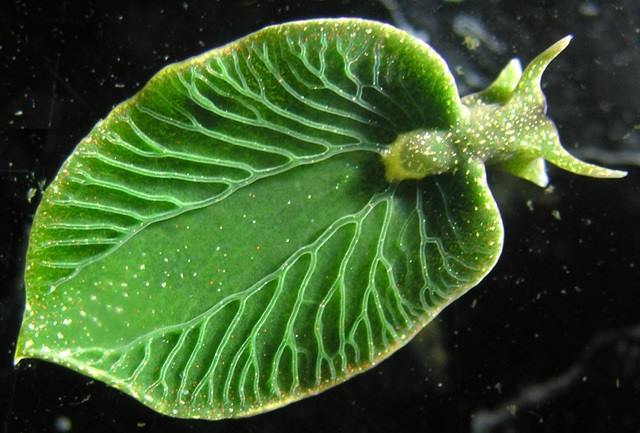
The sea slug Elysia chlorotica is a small marine gastropod, 5 cm long. It lives in shallow waters along the east coast of North America. This strange sea slug looks like a leaf. It’s green! When the sun shines, it spreads out, as if to make the most of the sunshine. How is this possible? Elysia chlorotica feeds on filamentous algae such as Vaucheria littorea. During digestion, the algae’s photosynthetic cells are only partially destroyed: their chloroplasts remain intact and enable Elysia to use the products of photosynthesis for nourishment. This is an example of chloroplast symbiosis or kleptoplasty [1], in other words, ‘chloroplast theft’. These chloroplasts contain chlorophyll, a pigment that captures light during photosynthesis, which gives the sea slug its green colour. They are present in the cells of its highly branched digestive system. This is why Elysia chlorotica resembles a green leaf. This characteristic appears to be specific to this family, as several closely related species exhibit the same behaviour. However, many protists behave in the same way.
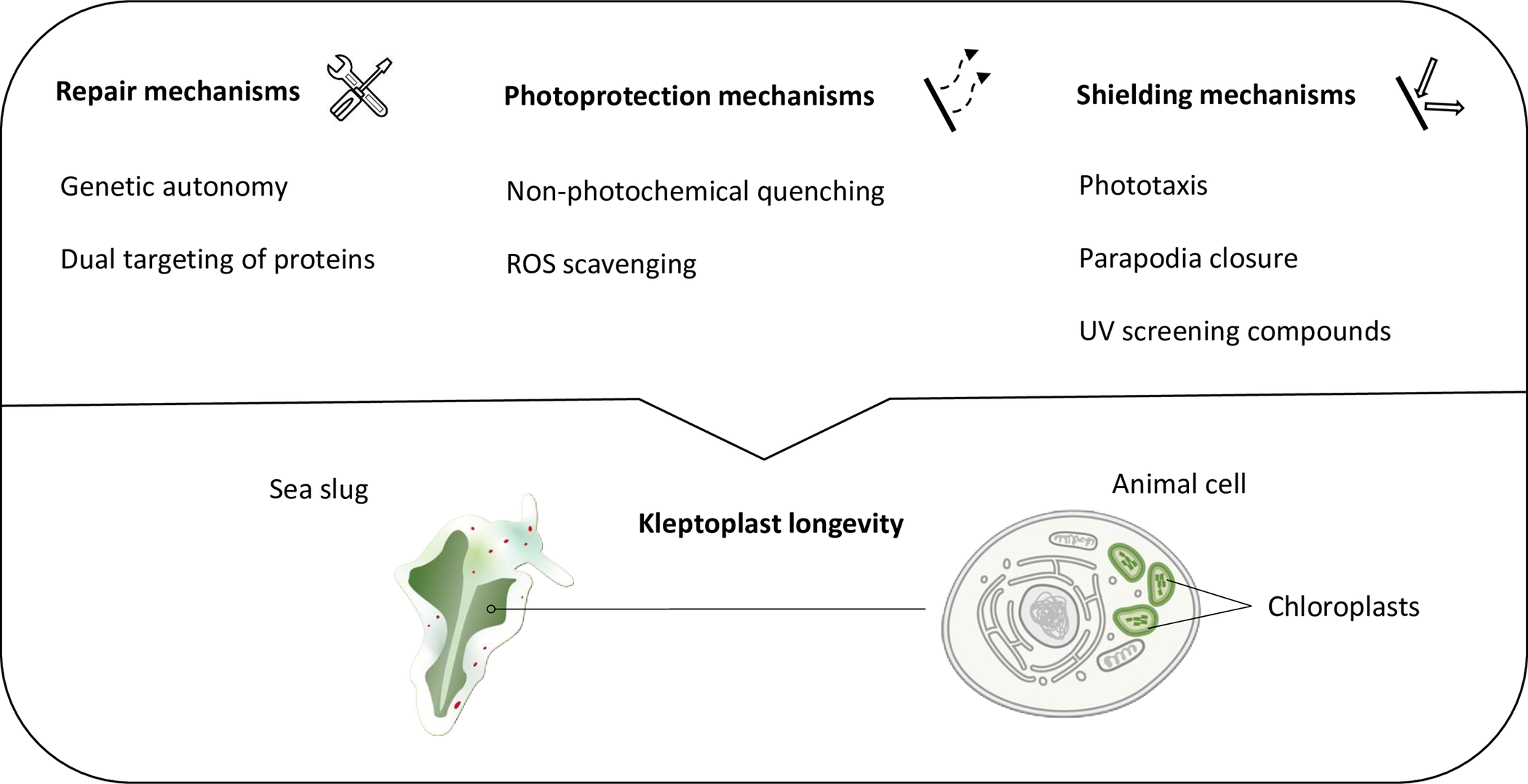
But for the slug Elysia chlorotica, things are very different. The mollusc acquires chloroplasts during its development, as it transitions from the larval to the adult stage, and keeps them functional for several months, or even nearly a year under certain experimental conditions. During this period, Elysia chlorotica appears to be able to manage without feeding on algae again, deriving a e proportion of its energy from photosynthesis. Experiments have shown that, in the presence of light and CO₂, Elysia chlorotica is indeed capable of incorporating CO₂ into its organic matter through photosynthesis. The exact role of this photosynthesis in the slug’s survival and reproduction remains, however, a matter of debate.
In plants, chloroplasts constantly require the import of proteins from the cytoplasm. The fact that chloroplasts sequestered within the sea slug’s digestive tract are capable of carrying out photosynthesis for several months, without the support of the algal nucleus, is therefore particularly intriguing. Early studies had suggested that genes essential for photosynthesis had been transferred from the alga to the sea slug’s genome via horizontal gene transfer (HGT) [2]. However, the complete sequencing of the Elysia chlorotica genome did not confirm the existence of a large-scale transfer of algal genes [3]. The mechanisms enabling chloroplasts to remain functional for several months are still being actively studied and remain a subject of debate. Elysia chlorotica nevertheless remains a remarkable example of kleptoplasty, that is, the long-term utilisation of chloroplasts taken from an alga [4].
To go further: Elysia chlorotica in action
A lecture on Elysia by Dr. Sidney Pierce at TEDx Tampa Bay (Florida, USA)
References and notes
[1] Rumpho M.E., Dastoor F.P., Manhart J.R. & Lee J. (2006) The Kleptoplast. In: Advances in Photosynthesis and Respiration – The Structure and Function of Plastids. R.R. Wise & J.K. Hoober, eds, Springer Pub., Vol. 23, pp 451–473
[2] Rumpho M.E., Worful J.M., Lee J., Kannan K., Tyler M.S., Bhattacharya D., Moustafa A. & Manhart J.R. (2008) Horizontal gene transfer of the algal nuclear gene psbO to the photosynthetic sea slug Elysia chlorotica. Proceed. Natl. Acad. Sci. USA 105, 17867–17871
[3] Bhattacharya D., Pelletreau K.N., Price D.C., Sarver K.E. & Rumpho M.E. (2013) Genome analysis of Elysia chlorotica egg DNA provides no evidence for horizontal gene transfer into the germ line of this kleptoplastic mollusc. Molecular Biology and Evolution 30, 1843–1852.
[4] Havurinne V., Handrich M., Antinluoma M., Khorobrykh S., Gould S.B. & Tyystjärvi E. (2021) Genetic autonomy and low singlet oxygen yield support kleptoplast functionality in photosynthetic sea slugs. Journal of Experimental Botany 72, 5553–5568.
[5] Cruz S, Cartaxana P (2022) Kleptoplasty: Getting away with stolen chloroplasts. PLoS Biol 20(11): e3001857. https://doi.org/10.1371/journal.pbio.3001857
Further readings
- Dabonneville C. (2013) Les animaux-plantes ou comment un animal peut-il être photosynthétique ? Espèces 9, 22-29. (in french)
- Biofutur (2009) special issue on “Endosymbioses”, n°299 (in french)