




Minerals: good for our health and that of plants
PDFMinerals play an essential role in our bodies: they perform vital functions, from building strong bones to transmitting nerve impulses, ensuring a long and healthy life. Their presence not only enables the production of various hormones but also regulates the heartbeat.
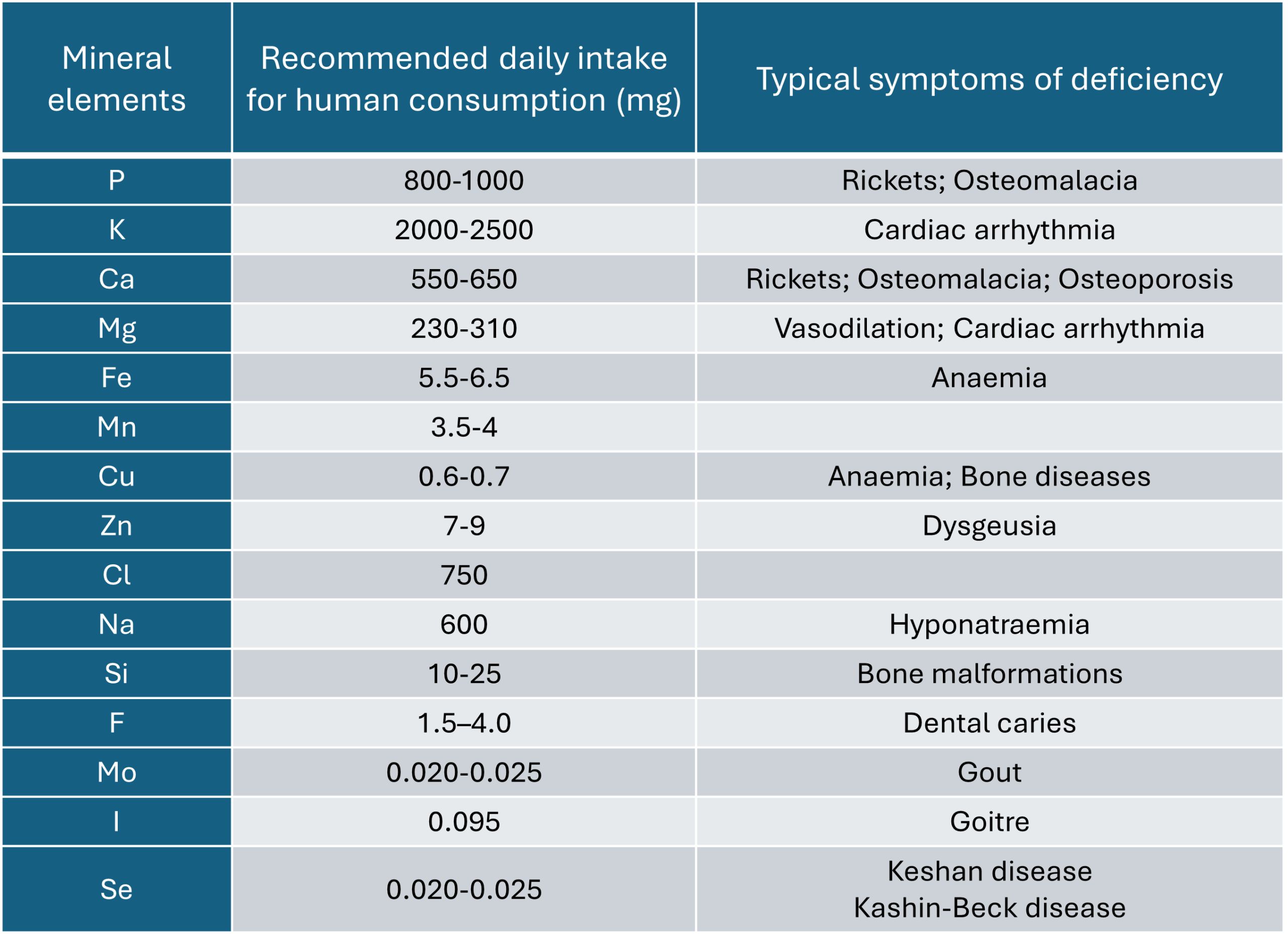
Certain macro- and microelements are found in the structure of teeth (Ca, P and F) and bones (Ca, Mg, Mn, P, B and F), while most microelements (Cu, Fe, Mn, Mg, Se and Zn) play an essential role as structural components of many enzymes. Minerals are also involved in the immune system (Ca, Mg, Cu, Se and Zn) and the brain (Cr and Mn) [1] (Table 1).
In addition, plants use these minerals to produce energy sources in the form of macronutrients (carbohydrates, proteins and lipids) and essential micronutrients. These micronutrients include vitamins (A, B complex, C, E and K), essential fatty acids (linoleic acid and linolenic acid) and amino acids, histidine, isoleucine, leucine, lysine, methionine, phenylalanine, threonine, tryptophan and valine. All these micronutrients must be obtained from food as they cannot be synthesised by humans and, except for vitamins B12 and D, a plant-based diet can provide an adequate supply. As with minerals, a dietary deficiency in these essential micronutrients can have long-term negative impacts on human health [2].
Table 1. Essential minerals for human nutrition. Adapted from Huang et al. (2020) [3]
All minerals are mainly absorbed from the soil by roots in the form of inorganic ions (see The root system of plants: from shadow to light). They enter cells via proteins that enable them to cross hydrophobic cell membranes. These proteins are either:
- High-affinity or low-affinity transport systems, which allow ions to be absorbed when they are present in the soil in low or high concentrations, respectively.
- Ion channels.
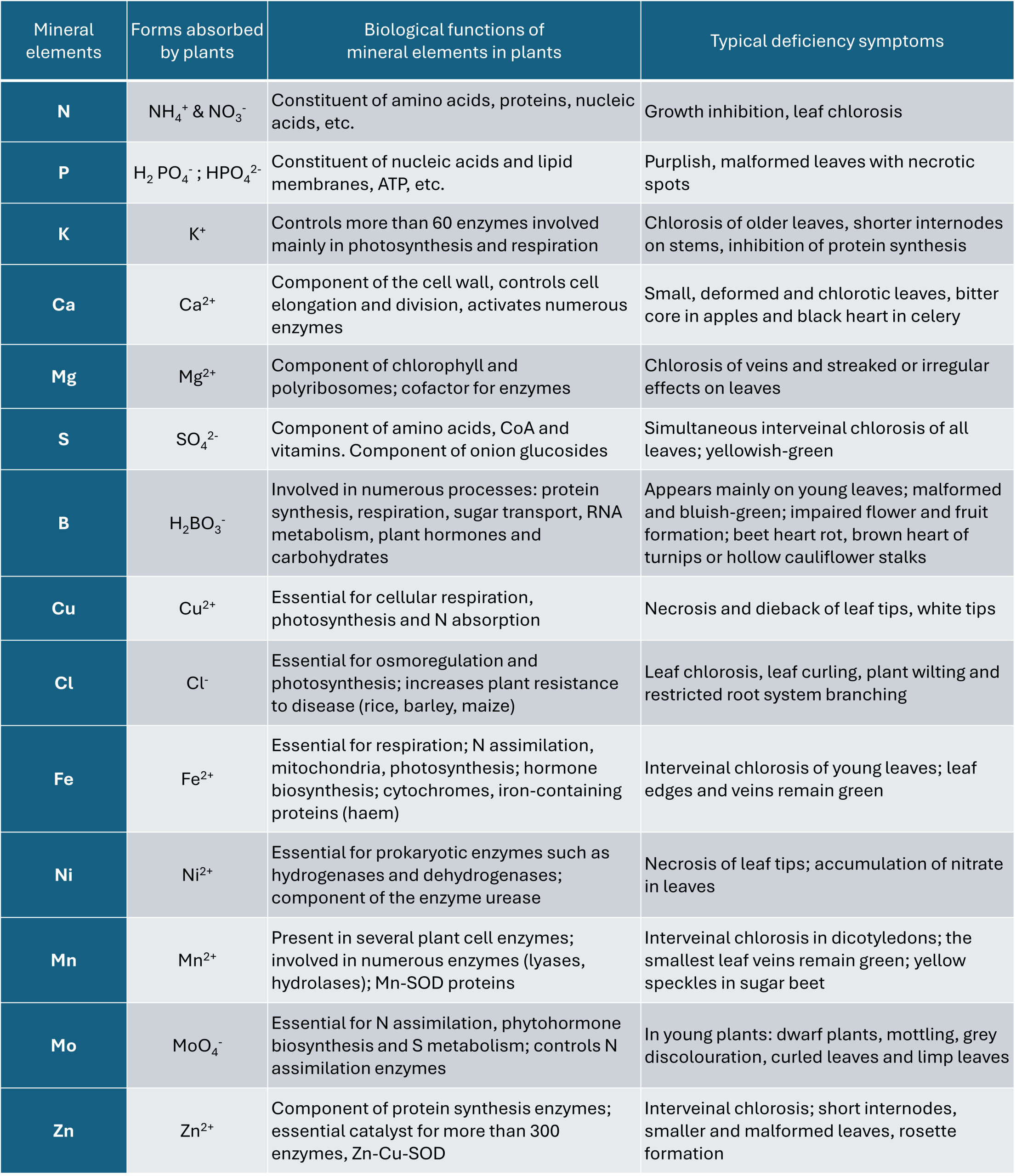
Once in the root symplast, inorganic ions are transported to the leaves and edible parts intended for human consumption via the xylem. These steps constitute a complex and finely regulated system: it adapts the quantities of ions taken up to the plant’s needs based on their availability in the soil and environmental conditions. Minerals play a crucial role in the plant’s metabolic functions. They are involved in the synthesis of essential organic molecules such as amino acids and proteins, fatty acids and nucleic acids. Any deficiency in any of these minerals therefore has a significant impact on plant growth and affects the yield and nutritional quality of plant production (Table 2).
Notes & references
Thumbnail. Summer (Table of the series The Four Seasons) by Giuseppe Arcimboldo [Dated 1563, Public Domain, via Wikimedia Commons]
[1] Gharibzahedi, S.M.T. and Jafari, S.M. (2017) The Importance of Minerals in Human Nutrition: Bioavailability, Food Fortification, Processing Effects and Nanoencapsulation. Trends in Food Science & Technology, 62, 119-132. https://doi.org/10.1016/j.tifs.2017.02.017
[2] Grusak MA, DellaPenna D. Improving The Nutrient Composition Of Plants To Enhance Human Nutrition And Health. Annu Rev Plant Physiol Plant Mol Biol. 1999 Jun;50:133-161. doi: 10.1146/annurev.arplant.50.1.133.
[3] Huang et al. (2020)